It is remarkably easy—and deeply misleading—for pop culture to romanticize Pattie Boyd as the ultimate rock-and-roll muse. To be the woman who inspired George Harrison’s timeless “Something” and Eric Clapton’s legendary “Layla” and “Wonderful Tonight” sounds like the stuff of fairy tales. Photographs capture her beauty, magazine spreads celebrate her style, and music history immortalizes her name. Yet beneath the glossy surface lies a story far more complex, fraught with psychological strain, emotional upheaval, and the often invisible costs of being caught between two extraordinary men at the height of their fame. To truly understand Pattie Boyd, one must look beyond the glittering photographs and the music she inspired and confront the turbulent reality of her life in the late 1960s and 1970s.
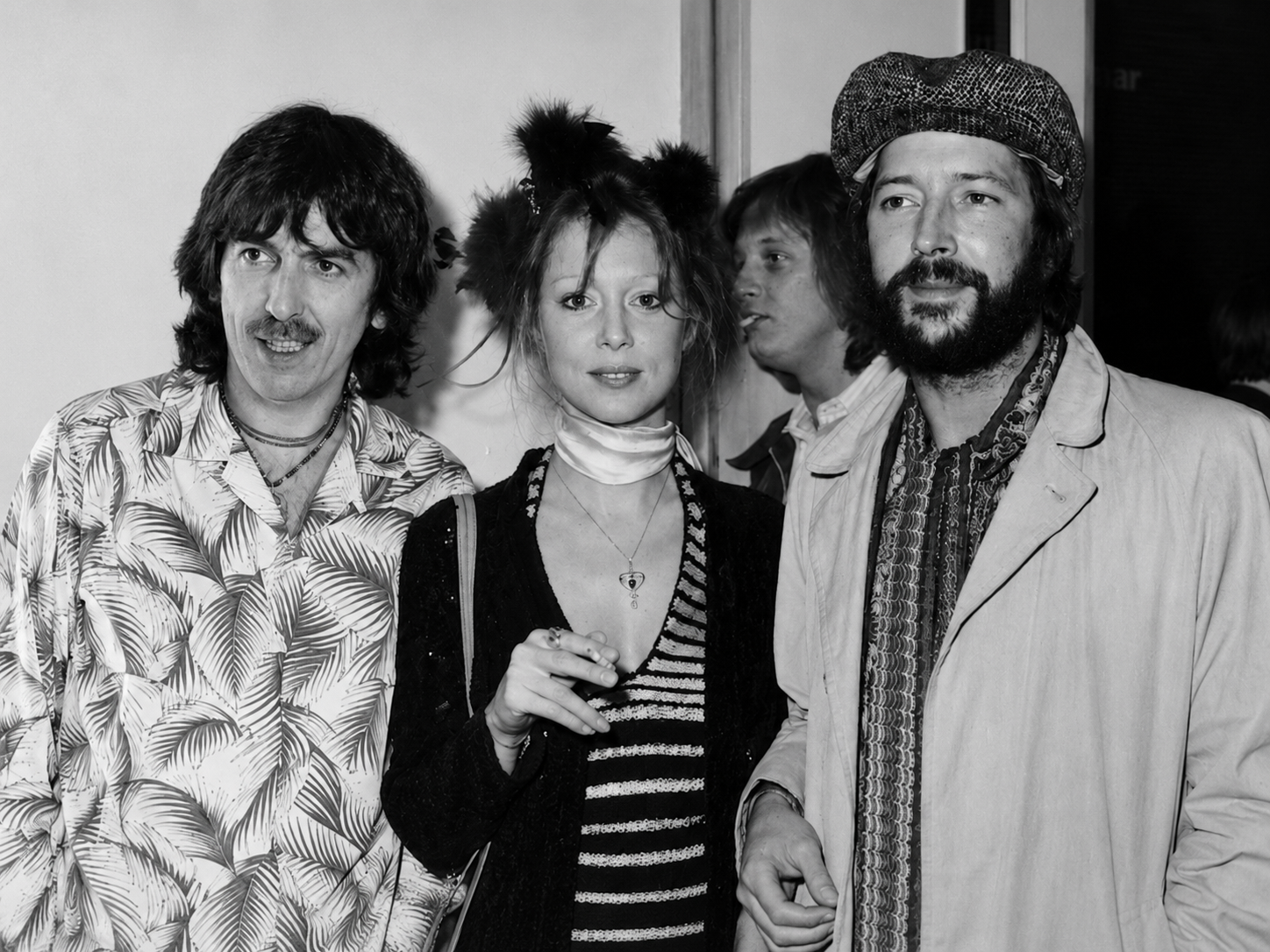
Pattie’s marriage to George Harrison began with sweeping passion and genuine love, a rare bond forged during the dizzying whirlwind of Beatlemania. But as the band’s relationships frayed, so too did George’s ability to remain present. He became increasingly introspective and spiritually focused, immersing himself in Eastern philosophies and the teachings of the Hare Krishna movement, while simultaneously engaging in chronic infidelities. At Friar Park, their lavish Victorian estate, a chilling distance gradually took root between them. What had once been a home filled with laughter and music became a cold and isolating space. Pattie, despite her devotion, often found herself navigating a marriage that was emotionally inaccessible, feeling abandoned even as she remained physically near the man she loved. She was more than a wife; she became a casualty of The Beatles’ fracturing fame and its ripple effects—a silent witness to the pressures of genius and the emotional fallout of an empire built on music and myth.
Then came Eric Clapton, George’s closest friend and a man whose love for Pattie would soon transform from admiration into obsession. While the popular narrative frames his pursuit as romantic, the reality was far more fraught. Clapton’s affection was aggressive, possessive, and inextricably tied to his spiraling heroin and alcohol addictions. Songs like “Layla” were not simply love letters—they were instruments of emotional pressure, ways to bend Pattie’s reality to the desires of a troubled genius. For Pattie, this was a terrifying duality: on one side, a husband she still loved but who was slipping further into spiritual and emotional isolation; on the other, a friend of her husband whose obsession threatened to destabilize her own life. The choice was never simply between two men—it was about survival, identity, and agency amid the pressures of fame and addiction.
The emotional whiplash Pattie endured was profound. She was caught between two of the most famous men in the world, each with enormous egos and personal demons, and she had to navigate the treacherous waters of loyalty, expectation, and public scrutiny. By the time she left George for Eric in 1974, peace remained elusive. Her escape did not end the torment; she traded one set of challenges for another, swapping George’s cold distance for Clapton’s volatile addictions and the subsequent betrayals of infidelity. Pattie’s struggle was not about romantic drama—it was a battle to maintain her sense of self while living as both a real person and an idealized muse in the eyes of the world.
Yet Pattie Boyd’s story is ultimately one of resilience and triumph. She survived the crushing weight of being a living muse, enduring heartbreak, obsession, and the shadow of two musical legends. Through it all, she reclaimed her life, her voice, and her identity—emerging as a gifted photographer, artist, and storyteller in her own right. Pattie transformed from a figure immortalized in song into a woman who could define her own legacy, demonstrating remarkable courage, perseverance, and the power to reclaim autonomy in a world that often sought to define her.
Her life teaches us that the true triumph of Pattie Boyd is not merely the music she inspired, but her ability to survive, to grow, and to assert her own humanity beyond the myth. She was more than a muse—she became her own masterpiece.